dinsdag 6 mei 2014

Material science 101

Being my inquisitive self, I have decided I would like to learn how the Finite Element analysis actually works. However having studied biomedical engineering this was not an obvious subject and I do not have the necessary background information to grasp it. So what do you do? 

I just finished the first lecture and what stuck was the following. I liked the part of putting energy usage in perspective. That we as dutch citizens have on average about 6 kW/s working for us compared to ~2 kW/s for the average world dweller is quite a difference.
Everyday energy costs, note the amount of energy it takes to power a house/car 
Moving on to the actual material science part of the lecture. I learned the basic properties of materials. Which you know by experience but I need to find how to get an intuitive grasp of these concepts. Take Elastic modulus for example... what does that mean, which materials have a high/ low Emod? high would be steel and low would be plastics... meaning... meaning... meaning... meaning that steel is harder to bend than plastics, right? correct me if I am wrong. 

The picture below helps kind off to make sense of these properties: 


All in all an interesting lecture and I am determined to follow at least 3 more lectures. The key to happiness is to set low expectations  :P 

maandag 13 augustus 2012

An all in one Macro - Excel Macro beginner

If you have to use excel a lot to create graphs and figures chances are that you have thought to yourself: ‘There has to be a way to automate this…’. And if you’re like me and know your way around Microsoft Office, you have the developer tab enabled and you’ve seen that button record Macro.image
“Ha! my tiresome repetitive tasks are over!” you think to yourself, but if you’re not used to programming in VBA, watch out! here is a pitfall I ran into so you don’t have to:

Trying to do everything in one Macro:

Macro’s so powerful, they can do everything you want. The problem is they need to be told exactly what to do and as a beginner you don’t know the language. (Try asking for directions in French for example and see if you understand the answer). So you have all this power under your fingertips, but no way to (quickly) use it. What I learned as a superficial Macro user is not to try everything in 1 Macro.
For example I had 10 sheets of raw data formatted exactly the same but needed to be set up differently and I wanted a graph plotted of each sheet. Trying to do that all at once resulted in a graph I couldn’t use and a Macro that was so specific it couldn’t be used for other sheets unless I did some serious tweaking. Which I did have the time nor experience for. So I went for the next best thing:
  1. Record a Macro of moving the raw data in the correct format
  2. Create a graph manually
  3. Record a Macro of adding all the titles and getting the correct formatting
This took me 5 minutes to set up and saved me 20. While trying to figure out how VBA took me 2 hours and it still doesn’t work.
So hope this helps you Macro beginners out there.

maandag 19 maart 2012

IOS 5.1 Improves responsiveness of the iPhone 4

I have my iphone 4 for almost one and a half years and it was starting to get sluggish. It was running on IOS 5.0. This resulted in long load times for the camera app and even jittery transition effects when changing homescreen pages. Now I have the 16 GB model and I thought it was due to it being almost filled to the brim with apps and music. But after freeing up 2 gigs it still had the same issues. Now I just upgraded to IOS 5.1 and everything works a smooth as it was in the beginning and even my camera app launches in about 2 seconds.

Bottomline: I like the IOS 5.1 upgrade!

zaterdag 18 februari 2012

Silencing the Smoby “Be Fun” push trike

In my first post on the Smoby Be Fun Trike I wrote that it is generally a good bargain priced tricycle with a handy push rod. The drawback however was that it was seriously noisy. In my second post I did some good ol’ problem analysis and thought of some ways to solve it. So in this final installment, my solution.

First on what do you need:

  • Smoby Be Fun Trike
  • An (old) inner tube of a bicycle tyre.
  • Scissors
  • Ducktape

Seriously that’s all

Noise solution smoby be fun trike 1

So what we are going to do is tape the bicycle tire tube to the wheels of the trike.  You start with measuring the circumference of the 3 wheels and cut the old bicycle tyre in according length. Then tape the pieces of tire tube to wheels using your trusty duck tape and there you have it a whopping 15 db noise reduction (remember that every 3 db the sound level is doubled).

There you have it, a simple solution to an annoying problem and one that can be done in 30 minutes with your basic household inventory. Enjoy!

Note: The picture shows my first solution using only ducktape. This worked for a while but after a few weeks of driving, the tape lost its dampening power. So I decided to add the tube for higher durability and increased noise reduction

donderdag 16 februari 2012

Daniel Daniel – Elly en Rikkert

Na een korte google actie kon ik de akkoorden van dit bekende kinderliedje niet vinden dus bij deze zelf uitgevogeld:

In “G”

Refrein:

G         C
Daniël, Daniël

G  
vertrouw op God,

      D
Hij hoort je wel (2x)


Em           D               C                 G
Als je in de kuil van de leeuwen ligt,

Em               D                    C           G
snoert Hij de muil van de leeuwen dicht.

    D
Al zien ze geel en groen,

D
ze kunnen je niets doen.

(Refrein)
Hoor je ze grommen, ze kijken zo woest,
hun tanden zijn al jaren niet gepoetst.
Ze lusten je wel rauw,
maar God beloont je trouw.

(Refrein)
Soms wordt er vreeslijk op me geknord,
lijkt het of ik opgegeten word,
zit ik in het nauw dan denk ik weer aan jou.
(Refrein)
Tekst en muziek: Elly en Rikkert Zuiderveld

Tags:

Elly en Rikkert, Chords, Akkoorden, hoe speel je, Daniel daniel, kinderliedjes, Christelijk,

dinsdag 16 augustus 2011

The smoby trike adventure part 2 – Finding the solution

In my last post on the smoby trike I bought for my son, I shared what horribly loud it was and what to do with it. It also talked about finding the root cause of the noise and what to do about it. The main noise factors are indeed the bucket and the wheels. So how do we get the noise down? Well let’s put our thinking caps on first: Sound, what is sound? Vibrations in the air. Our ears pick these up and they turn it into a signal that our brain recognizes as sounds. To put it simple:
Air (vibration) –> Ears –> Bain (Sound)
So these are our options, we can tweak our ears, our brain or the air. Sounds tempting to do something about our brain doesn’t it :)? But to do something about the vibrating air before it reaches our ears and is the more pragmatic and practical goal for some household hacking on the trike.
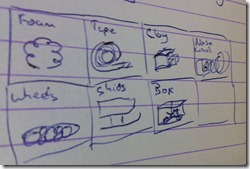
Let’s use another tool to generate some ideas about reducing the noise. It’s called a morphological scheme. Here’s how it works: you take a goal (make air vibrate less) and doodle what could help reach that goal with no concern for reality or feasibility. Here’s mine:
morphological scheme smoby trike
Now this is just to get the creative juices running to see broaden your scope. I can imagine my handwriting being illegible on the picture so here’s what I thought of: foam , tape, clay, noise cancellation, wheels, skids, box.
Now we have multiple solutions and tighten our scope and start to define our limits. For example
1. Price - Under 10 euro solution
2. Effect – It has to work
3. Endurance – has to withstand daily use

The solution?

Noise cancelation would be a cool idea to experiment with, you know add speakers in the wheels that try to cancel out the sound waves that are being generated. But alas to expensive/time consuming. Building a noise isolating box around the tricycle would work but make the trike rather unusable. And spraying foam around the wheels would help just until the wheels have turned one circle, and all the foam is left on the road, I think the same goes for clay. Changing the current wheels with skids or another will increase the complexity and cost. So I’m left with… Tape. The wrap up will be in a next post.

vrijdag 12 augustus 2011

My personal acoustic guitar buying guide, Introduction

Introduction

I recently purchased my third guitar over a time period of 7 years.
Guitars 400px
I started out with a classical nylon stringed Yamaha c-70 I got for my birthday. This got me learning guitar, thank you yamaha. After 4 years I switched over to a steel string Epiphone EJ-200 super Jumbo model. I just loved the sound and the looks. Getting the EJ really improved my playing because every song I played sounded new to my ears compared to my old guitar. After another 3 years it was time for a new guitar. Although I loved me EJ and I got attached to it, the sound couldn’t compare with an all solid guitar and because I could get a good price for it… I traded it in for an Eastman AC320CE which is a dreadnaught model. It did not have the flair of the EJ and I don’t like the looks of a dreadnaught much, but the sound was unbeatable. And that is first and most important thing about buying a guitar. Use your ears, they don’t lie and only they can tell you what the best sound for you is. And what is the point in buying an instrument that you don’t like the sound of?
I’ll end this section with a quote from Justin referring to scales over at justinguitar.com (amazing site by the way!):
If it sounds good, it is good
If it sounds bad, it is bad

The pointers

1. Use your ears
Your ears are two very complex high quality receivers. They will tell you more than a brand or price tag. Before I bought my EJ all guitars would tend to sound alike. So I went to the store multiple times and let my ears get used to the different sounds that guitars have. And by doing that I developed a liking for certain sounds and without a doubt the EJ-200 had the right sound for the right price for me.
That’s it for now. In my next post I’ll be looking into form factor and woods